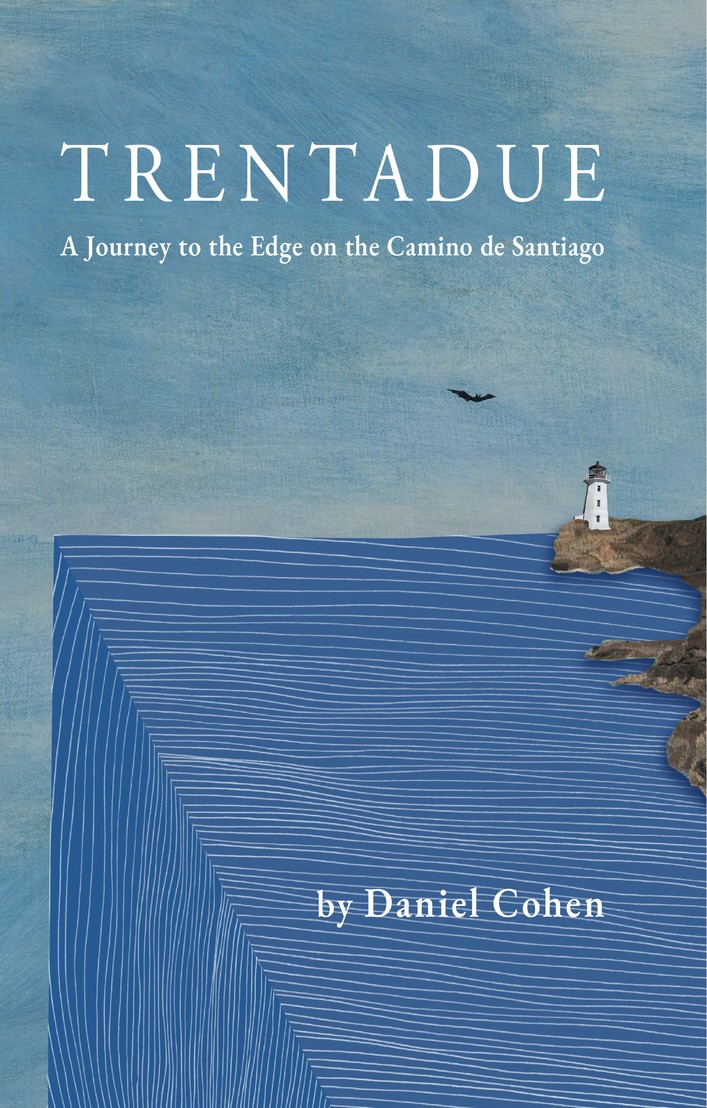
Fiction · Daniel Cohen
TRENTADUENewEnglish edition
A Journey to the Edge on the Camino de Santiago
Lupo Pitaro sets out across northern Spain on an ancient pilgrimage route of a religion not his own, not exactly knowing why. After all, he has everything he needs: a twice-divorced man’s apartment, two successful daughters, home delivery of his beloved newspaper. But age fifty has its own plan. Walking the green mountains and stone paths of the Camino de Santiago, Lupo can’t escape the feeling that something is following close at his heels. He reluctantly finds connection with fellow pilgrims and discovers that surrendering to the rhythm and serendipity of the way is his only option.
Available in Israel only
Order on BookPod with secure payment. Your copy is printed just for you and shipped directly.
From the book · Not Even a Prologue
Is my memory playing tricks again? Can a lifetime ago feel like just yesterday? Rifling through the top of my closet, my fingers blindly close around a tangle of straps and zippers. My old army backpack. I first felt its weight on my shoulders the morning of my enlistment, sweat dripping down my back in the sweltering summer heat. I pull at it, and it floats down, light like a falling leaf. Autumn has settled in my bedroom.
Oblong shaped. Padded back. Designed to carry heavy weights over long distances. The belly of that beast now grows steadily with clothing and gear—each item fundamental to my journey. The pack flops belly-up on the bed, bulging toward the bare bulb that dangles from the ceiling. Its fabric, stiff from disuse, groans as I half plead, half command, just a little more, using the weight of my body to stuff another shirt in. Our struggle ends with the growl of fabric tearing open like a gaping mouth down the front of the pack. Refusing to withstand the pressure of shirts, hiking pants, socks, and assorted gear, my dear old pack has—in a weird way—won the battle. Now it lies, may it rest in peace, in the trash, while my stuff forms a mountain on the bed.
I catch a glimpse of the time out of the corner of my eye and new worries arise as the seconds tick away. Only a few hours of sleep remain. My daughters are already sound asleep, but for me even half an hour of shut-eye feels laughable. The night is spent, dawn is approaching, and with it, my flight to Spain.
Continue reading →
∞
Perhaps it has to do with turning fifty. Milestone years spark subversive thoughts. Ideas catch fire. Bold, prickly notions propel the mind to seek out and break through new horizons. At thirty I divorced my second wife; at forty I renovated the apartment; and now, at fifty, I’m not sure, but I’m beginning to guess.
I would go to the doctor—especially now that with the passing of the lame dog my father bequeathed me, I suddenly have a lot more time on my hands. But I have no intention of falling into the waiting jaws of my daughter, the student, who would then gaze at me with reproachful eyes and exclaim, “I told you that a doctor would tell us what’s wrong with you!” Perhaps I really should work out more. Neighborhood walks are not enough. I can already imagine it: Mr. Pitaro, your body is weak. You’re not young anymore. When was the last time you had a checkup?
The jitters show a need for a journey that will work my muscles. No need for doctors or diagnoses. Just a trip that will give my organs the space to realign inside my body. A journey to calm the rapid beatings of my heart. I mean I’ve always been active. And thirty days of annual reserve duty has always brought me back to life—taut, agile, alert. That’s the feeling I’m missing as everything marches forth from the age of fifty, to sixty, then seventy, until the day my daughters lay a suffocating stone over me.
But before I write a will, I will take this trip. Its time to part ways with the Scottish bottle, that pudgy vessel that doesn’t seem to run out of “medicine” despite days of savoring its sherry and oak flavors—a smoky addictive taste, rich like layers of cake.
“Girls, I’m going to Roncesvalles to walk the Camino de Santiago—it’s in the Pyrenees between France and Spain. Or maybe I’ll start in Pamplona, that city with the festival where bulls run through the streets and people run out in front of them. Or maybe Saint-Jean-Pied-de-Port on the French side . . .”
My eldest daughter quickly Googles these far-off names on her phone. “Papa, you’re not like converting or something, are you?”
This is one of the issues with her. An overdose of intellect and focus can limit one’s ability to think.
“Honey, why would I be converting?”
“Because it says the Camino de Santiago is a pilgrim route,” and she quotes, “One of the three great pilgrimages of the ancient world since the beginnings of Christianity.”
“And so what if it is?” I respond with the question that always wins. There’s nothing she can come up with that will hold me back—too difficult, not worth it, too far, steep, exhausting, lonely, reclusive, isolated. The words she homes in on are just words that people wrote because that’s how they felt. I’m unmoved by their feelings. And then my youngest, ever-determined, chimes in, “Papa, you can’t just leave like that!”
“What do you mean, ‘like that’?” I counter. She nudges me, with a touch of compassion.
“Without going for a check-up and while you’re depressed. Take care of yourself before setting off on a young man’s journey.”
So here we are: one daughter meticulously gathering information online, trying to figure out this place her father is fixated on, and the other resolutely insisting that someone objective—because it’s only been a week since I last heard the words someone objective, meaning a doctor, or maybe even a psychiatrist—assess my current state and only then objectively recommend what I need to do to prepare for a journey such as this.
“Because, Papa, you need to be prepared.”
About the author
DANIEL COHEN is an Israeli journalist and photographer born in 1964. Daniel began walking the Camino after an injury, seeking a way to heal body and spirit. What began as physical recovery evolved into a long inner journey through solitude, loss, and renewal. Over the past fifteen years he has walked the Camino Francés, Via de la Plata, Camino del Norte, Camino de Fátima, Camino Finisterre, Camino Portugués, and others, at times retracing his steps, exploring how every ending may also mark a beginning. His paths often lead him to the edge of the world—Finisterre and Muxía—where sea and sky merge, and the road dissolves into silence.
Questions, or just want to say hello?
I would love to hear from you, about the book or about the Camino.
שאלות ותשובות עם המחבר (Q&A with the author, in Hebrew)